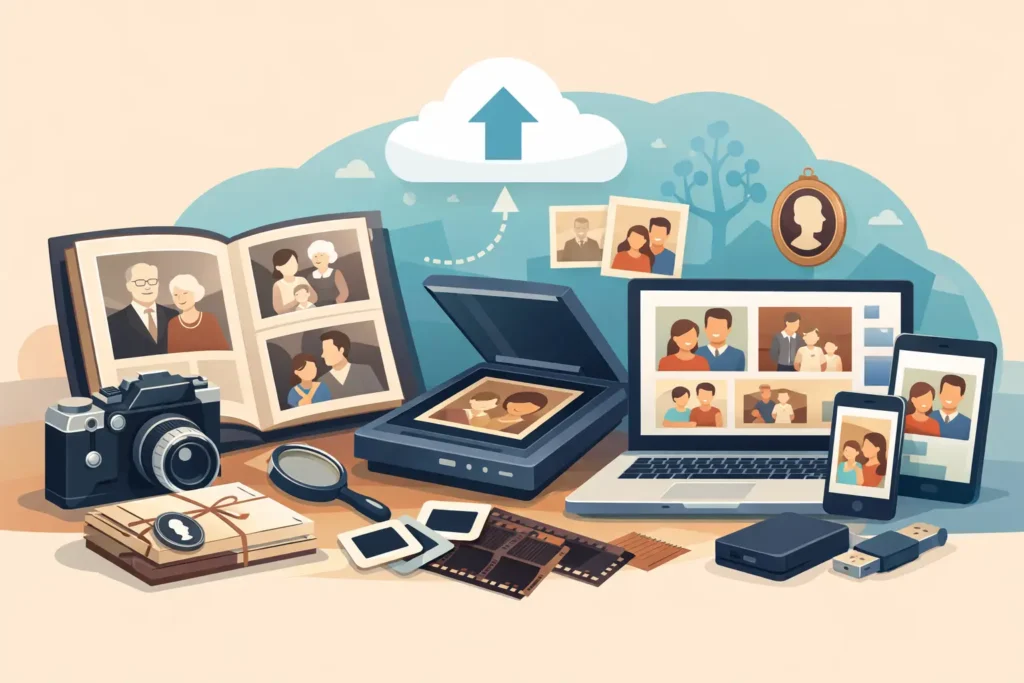
That box in the loft may contain more than old tapes and photographs. It may hold a child’s first steps, a wedding speech from someone no longer with you, a grandparent’s voice, or film from family holidays that nobody has watched for years. This family history digitisation guide explains how to protect those priceless moments before ageing media, fading images and obsolete players make them harder to enjoy.
The aim is not to turn your home into an archive or make you a technical expert. It is to make sensible choices, keep original items safe and create copies your family can actually watch, listen to and share. A little preparation now can give treasured memories a new lease of life for generations.
It is tempting to begin by sorting every tape, album and disc in date order. For many families, that becomes an overwhelming project before the first item has been preserved. Start instead with the material that would hurt most to lose.
Look for footage of older relatives, births, weddings, school plays, family celebrations and recordings made on formats you can no longer play. Also set aside anything showing signs of damage, including mould, cracked cases, warped discs, loose tape or photographs stuck together. Do not try to force damaged media through an old player. A jammed cassette or faulty machine can cause further harm.
Make a simple inventory as you go. A notebook, spreadsheet or notes app is enough. Record what the item appears to contain, its format, any date you know and where it is stored. Labels such as “Mum’s 60th, 1998” or “Camcorder tape – Cornwall” are useful even when the exact date is uncertain. The information will help you prioritise the transfer and label the finished files properly.
Different formats age in different ways, but none should be assumed safe simply because it has been stored away. Video tape can deteriorate gradually, and the machines needed to play VHS, VHS-C, Hi8, MiniDV and camcorder tapes are becoming harder to find in reliable working condition. A tape that played perfectly a decade ago may now show picture noise, sound problems or tracking faults.
Film reels such as Super8 deserve similar care. They can be especially valuable because they often contain footage from decades before home video became common. Keep reels cool, dry and away from direct sunlight while you arrange scanning or transfer.
Photographs, negatives and slides can fade, scratch or suffer from damp. Their condition is affected by light, humidity and the materials used in albums or storage boxes. Old CDs and DVDs may also fail without obvious warning, while floppy disks and older data discs rely on equipment that is increasingly uncommon.
Audio needs attention too. A cassette of a relative speaking, a MiniDisc recording of a school concert or vinyl from a family event can be every bit as meaningful as a video. If it tells part of your story, it is worth considering for digitisation.
Before packing anything for transfer, organise items into small, manageable groups. You might begin with one person, one decade or one event. This makes it easier to check that nothing has been missed and avoids sending a large collection with no idea of what it contains.
Keep each tape, disc or bundle of photos in its original case or sleeve where possible. If a case is missing, place the item in a clean protective bag or wrap it lightly so it cannot rub against other media. Do not stick labels directly onto photographs, film or the recording surface of discs. A separate note is safer.
It helps to number each item and match that number to your inventory. For example, “Tape 01” can correspond with “Christmas Day, around 1994, VHS”. Even if a label is vague, retain it. A note written years ago by a parent or grandparent may later become a valuable clue.
If several relatives have items from the same occasion, do not assume they are duplicates. One camcorder tape may capture the ceremony, while another includes informal moments before and after. Preserving both can create a fuller family record.
Digitisation is most useful when the result suits the way your family will use it. A digital video file is usually the easiest option for watching on a computer, smart television or tablet and for sharing with relatives. Common formats such as MP4 are convenient for everyday viewing, while AVI or MOV files may suit particular devices or editing software.
A USB is a straightforward physical keepsake and can be a welcome choice for relatives who prefer something tangible. DVDs still have a place too, particularly for households with a DVD player or for giving a clearly labelled copy to a grandparent. The best choice is often not one format alone. A digital file for convenience, plus a USB or DVD copy, gives you more than one way to access the memories.
Think about naming before files arrive. A folder named “Family Videos” will soon become confusing. A clearer system might be year first, followed by event and people involved: “1998-08 – Davies Family – Tenby Holiday”. Where dates are uncertain, use “c. 1998” or “late 1990s” rather than guessing. Accurate context matters more than perfect detail.
Your original media is irreplaceable, so choose a service that treats it accordingly. Ask whether tapes, photos and discs are handled in-house or passed through several locations, how they are identified and stored, and whether there is a clear process for returning them. Confidential handling is not an extra when dealing with private family footage. It should be standard.
For postal orders, use a sturdy box rather than a thin mailing bag. Place tapes or discs in cases where you have them, fill empty space with packing material and include your contact details and order information inside the parcel. Use a tracked service and keep your proof of posting until everything has been returned safely.
If you are nearby, an in-person drop-off can offer extra reassurance and a chance to ask questions about formats and outputs. VHS To DVD Ltd handles original media in-house in Llanelli, with postal and local drop-off options for families who want a personal, straightforward service.
When your digitised files or discs arrive, set aside time to test them promptly. Watch sections from the beginning, middle and end of each recording. Check picture, sound and labels. Old recordings can contain imperfect footage because of the original camera, tape condition or recording method, but it is still worth raising any concerns quickly with the provider.
Once you are happy, make more than one copy. A useful approach is to keep one copy on the supplied USB or disc, another on a computer or external hard drive, and a further copy stored separately. This could be with a trusted relative or in a reputable cloud storage account. The point is not to rely on one device, one cupboard or one person.
Do not throw away originals after transfer unless you have a very clear reason. The original may be useful if technology improves, if you later want a different type of conversion, or simply as part of the family collection. Store tapes upright in a cool, dry place away from radiators, loft heat and damp garages. Keep photographs in acid-free sleeves or albums where practical, and avoid basements prone to moisture.
A digitised recording preserves what the camera captured, but not always the details that make it meaningful. Sit with a parent, grandparent, aunt or uncle and watch a few clips together. Ask who is in the frame, where it was filmed, what happened that day and why the occasion mattered.
Write these details into your folder names, a document stored alongside the files, or a printed note kept with your USB. A few sentences can transform an unnamed party from 1987 into a story your children will understand. If someone remembers a name differently, record both versions rather than losing the conversation.
You do not need to complete an entire family archive in one weekend. Begin with the one tape you would be devastated to lose, the packet of slides nobody has seen in years, or the cassette carrying a familiar voice. Preserving one small part of your family history is already a gift to the people who come after you.