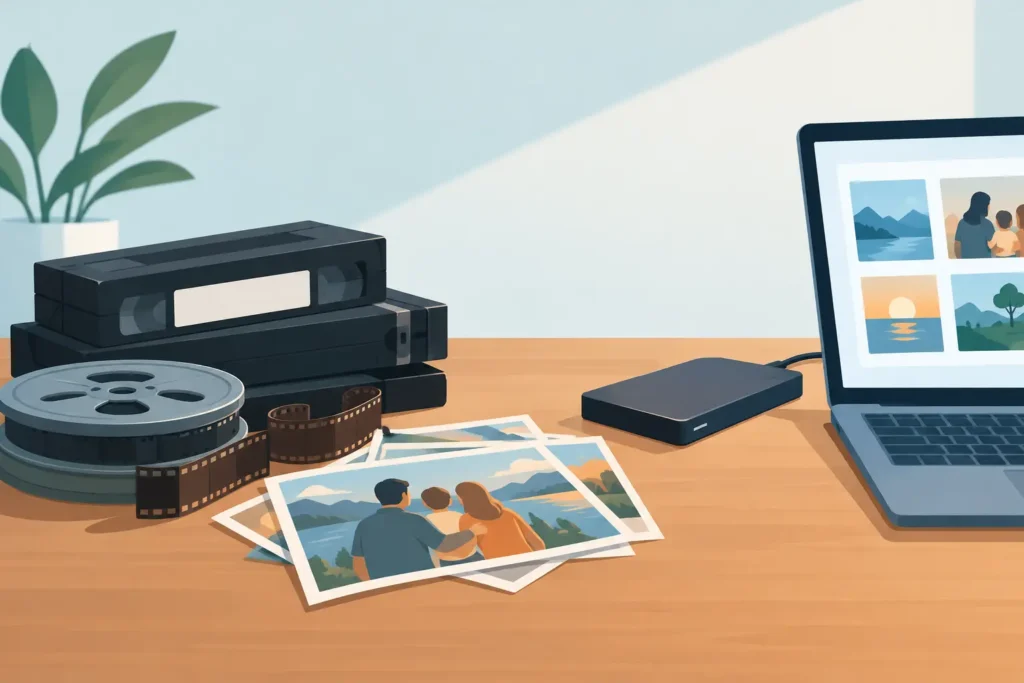
That VHS tape in the loft may still hold a child’s first steps, a wedding speech or a Christmas morning nobody has watched for years. Yet format obsolescence means the problem is no longer just whether the tape still plays. It is whether there is a working machine left to play it on – and someone who knows how to handle it carefully.
Many family archives are perfectly ordinary objects: a carrier bag of camcorder tapes, a drawer of MiniDiscs, a stack of photo slides or an old computer disc with no obvious label. They are easy to put off sorting. But as playback equipment disappears, each year can make treasured footage, photographs and recordings harder to reach.
Format obsolescence happens when the equipment, software or connections needed to access something are no longer widely available or supported. The original item may not be broken at all. A MiniDV tape can be physically sound, for example, but useless to a household that no longer owns a MiniDV camcorder or FireWire-equipped computer.
This is why preserving old media is different from simply storing it safely. A tape in a dry cupboard may avoid some damage, but it does not solve the question of access. If the player fails, spare parts become scarce or the right cable is no longer made, a family recording can become effectively locked away.
VHS is the best-known example. Video recorders are no longer a standard household item, and the machines that remain can have worn belts, dirty heads or tracking faults. The same is true of VHS-C, Hi8 and Video8 camcorders. DVD players are still common, but even DVDs and Blu-rays can be affected by scratches, disc rot and the gradual move away from optical drives in laptops and televisions.
Digital files are not automatically exempt. Footage saved on an old hard drive, floppy disk or DVD may depend on a particular programme, file type or device. An AVI, MP4 or MOV file is often easier to use than an ageing tape, but it still needs to be kept somewhere sensible and copied forward when your storage changes.
Technology moves on far faster than family archives do. Manufacturers stop making machines because demand falls, repairers have fewer parts, and the people who understand a particular format become harder to find. A machine bought second-hand may work once, then fail halfway through the very tape you hoped to save.
There is also the condition of the original media to consider. Magnetic tape can lose quality over time. It may suffer from mould, stretching, signal drop-outs or sticky residue. Audio cassettes, reel-to-reel recordings and MiniDiscs have their own ageing issues. Photographs, negatives and slides can fade, curl, scratch or gather dust.
None of this means every old tape is beyond help. Quite often, a tape that has not been played for decades still contains watchable footage. The difficulty is that waiting gives you fewer safe options. The longer you leave it, the more likely it is that both the media and the means of playing it will become a problem at the same time.
These risks are related, but they are not identical. Deterioration is physical: a damaged tape, a scratched disc, faded colour or a mouldy cassette. Obsolescence is practical: no compatible player, no suitable cable, no working software, or no one able to transfer the material safely.
A tape can deteriorate while you own a perfectly good player. Equally, a well-preserved tape can become inaccessible because its camcorder has stopped working. Families often discover this only when they want a clip for a milestone birthday, a funeral tribute or a wedding. By then, there may be little time to search for equipment or test several old machines.
Preserving memories before there is an urgent occasion gives you more choice. You can decide what format suits the family, check the results and make copies for relatives without rushing the process.
There is no single best output for every household. It depends on how you want to watch, share and keep your memories.
DVD remains a familiar choice for people who like to put a disc into a player and watch footage on the television. It can be a lovely physical keepsake, especially as an extra copy for a parent or grandparent. However, it is wise not to rely on a DVD as the only archive, because disc drives and players are less common than they once were.
A USB drive is convenient for keeping a collection together and viewing files on a compatible computer or smart television. Downloadable files are useful if relatives live apart and you want to store copies on more than one device. MP4 is generally a practical format for straightforward playback and sharing, while AVI or MOV may suit particular editing or viewing requirements.
The safest approach is usually to keep more than one copy in more than one place. For instance, you might have a USB drive at home, a copy on your computer and another stored securely by a close family member. What matters is that you can find the files, open them and revisit that arrangement every few years.
You do not need to be an expert to begin. Gather tapes, discs, photographs or audio recordings in one place and make a simple note of what they are. If a tape has a label saying “Summer 1994” or “Mum’s 60th”, leave it in place. Those small details are often invaluable when you come to organise the transferred files.
Avoid testing a tape repeatedly on an old or unreliable machine. If the cassette looks mouldy, damaged or unusually loose, do not force it into a player. Keep media away from radiators, damp sheds, direct sunlight and strong magnets. Store tapes upright where possible, and place discs in cases rather than loose stacks.
If you are sending originals by post, pack them snugly in a sturdy box so that they cannot move about in transit. Include your contact details and any instructions that will help identify the contents. Using a tracked service adds reassurance for items that cannot be replaced.
A professional transfer service can be especially useful when you do not have a dependable player, your collection includes several different formats, or the contents are particularly precious. VHS To DVD Ltd handles original media in-house and treats personal recordings with the confidentiality they deserve. Footage is retained for 30 days after transfer, allowing time to raise any questions or order additional copies, with a stated seven-working-day turnaround target for standard work.
Home-video tapes are only part of many family histories. A cassette may contain a grandparent’s voice. Vinyl records can hold a local band, a family performance or a recording made for a special occasion. Slides and negatives may be the only copies of holidays, childhood homes and relatives who are no longer with us.
Older data can be just as meaningful. Floppy disks, old CDs and DVDs sometimes contain scanned photographs, letters, documents or early digital camera images. Their labels may be vague, but their contents can be a surprise worth recovering.
You do not need to convert every item at once. Start with the formats you cannot currently play, the tapes that contain major family events, and anything with a visibly ageing or fragile appearance. That is often enough to turn an overwhelming cupboard-clearance job into a manageable preservation plan.
The aim is not to replace the original object or erase its history. It is to give the memory inside it a usable future. Choose one tape, one disc or one small box this week, label it clearly and take the first step towards hearing those familiar voices and seeing those priceless moments again.