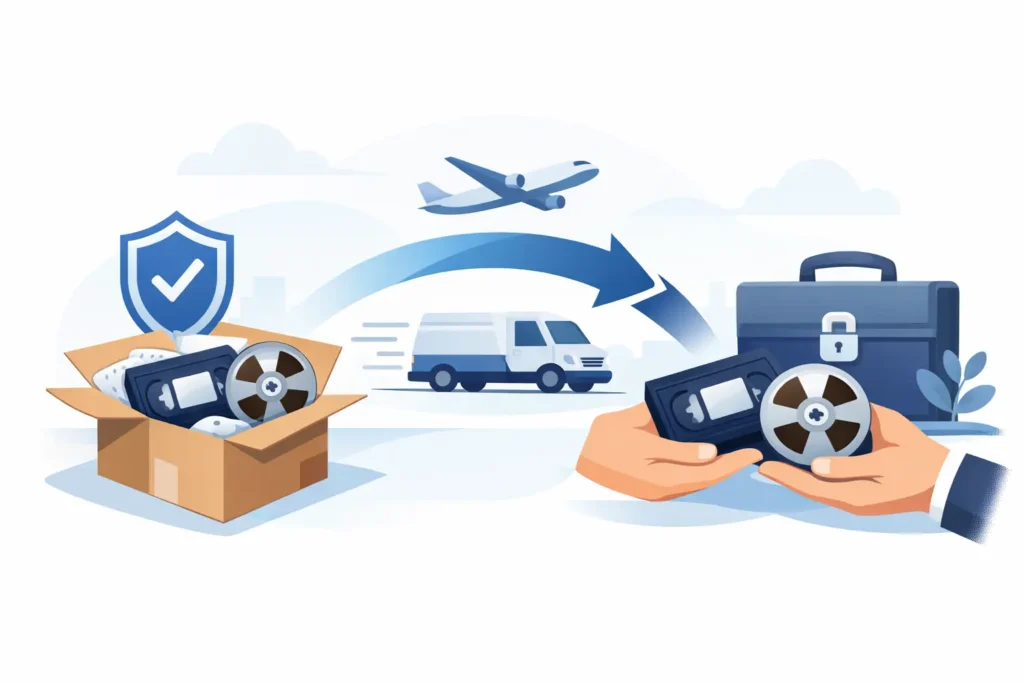
A box of family tapes is never just a box of tapes. It may hold a child’s first steps, a wedding speech from someone no longer with us, or a Christmas morning that nobody has watched for years. So, are original tapes returned safely? They should be handled with the same care you would give them yourself, from the moment they arrive to the moment they are back with you.
At VHS To DVD Ltd, we understand that customers are placing private, irreplaceable memories in our hands. That is why original media is handled in-house rather than sent away to an anonymous bulk-processing centre. Careful handling, clear labelling and sensible posting arrangements all play a part in keeping your tapes protected while they are being transferred and returned.
Yes. Once your conversion is complete, your original tapes are returned to you with your chosen output, whether that is DVD, USB or digital files. The exact return method can depend on how you placed your order and the delivery option selected, but the aim is always the same: your originals should travel back securely, clearly identified and kept together with the right order.
The safest service is not only about the journey home. It starts long before then. A tape can be damaged by poor packing, confusion between orders, unnecessary handling or being passed between several locations. Keeping the work in-house reduces those handovers and gives a small, accountable team a direct view of your items throughout the process.
For many families, this personal approach matters as much as the digital result. A new MP4 file can be copied and shared with relatives. The original cassette, however, may be the only physical record of a particular chapter in family life.
After your tapes arrive, they are logged with your order details and prepared for transfer. Each format needs appropriate equipment and care. VHS, VHS-C, Hi8, MiniDV and Super8 recordings can all have different age-related issues, from fragile tape and worn casings to picture drop-out or a recording that has not been played for decades.
The purpose of transfer is preservation, not simply making a quick copy. Your footage is played through compatible equipment and captured into a modern format so it can be viewed without relying on ageing camcorders or video players. Where possible, the process is kept straightforward and gentle. Repeated playback is avoided because every old tape has a limited remaining life.
Your personal footage is treated confidentially. These are not stock videos or disposable recordings. They are often deeply private family moments, and they deserve respectful handling.
Once the transfer has been completed, the digital footage is kept for 30 days. This gives you a useful window to check that you can play your files or discs and to raise any issue with the output. It is also reassuring if you need an additional copy shortly after receiving your order. After that period, it is sensible to keep your own backup in more than one place, such as a USB drive and a computer or secure storage device.
If you are posting tapes to be converted, the first part of their safe return journey is the way they leave your home. A little care at this stage helps protect the cassette cases, reels and labels from knocks, damp and movement in transit.
Use a strong cardboard box rather than a flimsy envelope. Put each tape in its case if you have it, then cushion the contents so they cannot slide around. Bubble wrap, scrunched packing paper or other clean padding can help. Avoid packing tape too tightly against cassette cases, especially if they are brittle with age.
Include your name, contact details and order reference inside the parcel. This is particularly helpful if the outer address label is damaged. If you have several tapes, number them and make a simple list of what is included. You do not need to know the exact contents of every cassette – labels such as “Mum and Dad’s wedding” or “Summer holiday 1994” are enough to help you identify them later.
For anything precious, use a postal service with tracking and retain your proof of posting until your finished order is safely back with you. Tracking does not remove every risk, but it gives both you and the service provider a clear record of the parcel’s progress. It is a practical safeguard for items that cannot truly be replaced.
Tapes often arrive with faded handwriting, duplicate labels or no label at all. A note inside the parcel prevents uncertainty, particularly when you are sending a mixture of formats. Write down the number of items, the format where known, your preferred output and the best way to contact you if a question arises.
If a tape has visible mould, a cracked case, loose tape or another obvious fault, mention it before sending it. Do not attempt to repair it with household tape or force it into a player. A damaged cassette may still contain treasured footage, but it needs a more cautious assessment.
Some conversion services collect orders and send them elsewhere for processing. That arrangement can work for some jobs, but it adds extra movement and extra points where an order can be delayed or separated from its paperwork. For irreplaceable home videos, many customers prefer to know who is doing the work and where their originals are being kept.
In-house processing means your tapes are not routinely passed through a chain of unknown facilities. It also makes communication easier. If you have a question about an order, want to add another tape or need to discuss the output format, you can speak to a real team that understands the service rather than a distant call centre.
This is especially helpful for local customers who prefer to drop items in personally at the Llanelli premises. Handing over a box face to face can offer extra reassurance, and it avoids the outward postal journey altogether. Postal submissions remain a convenient option for customers across Wales and the wider UK, but having both choices lets you decide what feels right for your family archive.
A stated target of seven working days helps you plan, but it is best viewed as a target rather than an unbreakable promise. The condition of the tapes, the number of items, the type of format and postal timings can all affect the overall schedule. Old media is unpredictable, and careful work is more valuable than rushing a cassette that needs attention.
When your order is ready, check the returned package promptly. Make sure the number of original tapes matches the number you sent, then test your DVD, USB or files on the device you intend to use. If you have ordered discs and one is faulty, replacement protection provides reassurance. Checking during the 30-day retention period gives the best opportunity to resolve any playback issue while the transferred footage is still held securely.
It is worth remembering that a successful transfer does not make the original tape worthless. Keep it somewhere cool, dry and away from direct sunlight, strong magnets and damp. The digital copy gives your memories a new lease of life, while the original remains an important part of the archive.
Before packing your tapes, take quick photographs of the labels and the contents of the box. This is not because you should expect a problem. It simply gives you a handy record of what you have sent and may help you organise the finished files later.
Choose an output that suits how your family will watch and share the footage. DVDs can be lovely for gifting, USB is convenient for modern televisions and computers, and MP4 files are usually the easiest format for sharing with relatives. If you are unsure, ask before sending your order. A straightforward conversation can prevent disappointment later.
Most importantly, do not wait for the perfect time to deal with old tapes. Magnetic media deteriorates gradually, and the machines needed to play it are becoming harder to find. Pack them carefully, keep a record of what you send, and choose a preservation service that treats every cassette as the priceless piece of family history it is.