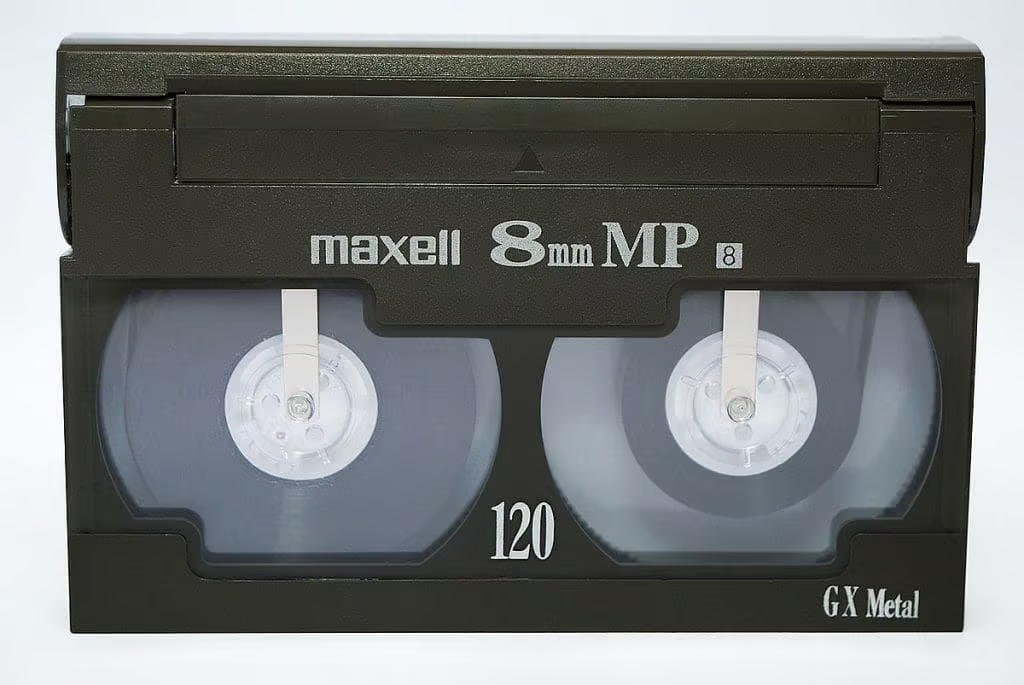
Hi8 and 8mm have been among some of the most popular videotapes in different formats. The 8mm tape was released before the release of Hi8, after which the Digital8 was released. Both 8mm and Hi8 tapes have films of a width of 8 millimeters, a size little less than half of an inch. Both tapes come in cassettes that look like audio tapes, and both are pretty much recent developments that came out in the ’80s. These replaced VHS tapes with their smaller sizes, becoming quite handy and popular in the mass.
How are the Tapes Different?
While both have a lot of similarities to share, there are some points that make these audio tapes different from each other. Comparing it to the present day will be like comparing HD and 4K television. You could use an 8mm film in the Hi8 that points the latter to be backwards compatible. However, you could not use the Hi8 tape in its president’s camera.
Sony stopped making 8mm tapes back in 2007 as the tapes have become old news now. If you are a hoarder by hobby or interested in collecting cool stuff from the ’70s and ’80s, then finding these could be challenging for you.
On the other hand, Hi8 had better media formulation and improved recorder electronics used to improve the picture detail. Hi8 equipment also supported playback and recording of the 8mm tapes as discussed previously, which made them popular for a long time.
The video format for 8mm points to three formats for videocassettes that work for the following systems:
These come from the original Video8 format with even more recent development in its recording format called the Digital8. Developed by Sony and Kodak, it used the interlaced video as the standard with a Helical scan as its writing and reading mechanism.
Hi8 was the improved version of Video8 having higher resolution. It was developed for competing with the equivalent of VHS, S-VHS. Both of the formats had 400 lines for resolution in the horizontal format that put them in a low range of quality in broadcasting. Hi8 camcorders were quite famous among hobbyists and enthusiasts. Moreover, these camcorders also found their use in different television productions requiring portable and lighter equipment.
Moreover, the Hi8 used a mixture of better quality tape with better recording mechanisms for an improved bandwidth of the tape, just like S-VHS. The total lengths for recording were half an hour, an hour, and up to two hours. The better options of Hi8 had XR capability as well as PCM digital audio that enhanced the overall picture quality. However, with time, even the most advanced form of the Hi8 got the MiniDV and Digital8 as the replacement.
In a nutshell, these tapes are compared as under:
| 8mm | Hi8 |
| Older version | Newer version |
| Not backwards compatible | Backwards compatible |
| Lower quality resolution | Higher resolution analog format |
| Does not use combination of tapes | Uses combination of tapes |
Final Verdict
Even though these differences are based on their development gap between each other, these are not very notable, a reason why many people often mistake one for another. We hope this guide helped you find those little differences that give Hi8 and 8mm their individuality.